Thursday, November 7, 2013

#58 The Gold Rush (1925)

#58 The Gold Rush (1925)

 photo GoldRush3_zps885dcb97.jpg

Another Chaplin film -I ended up watching 3 total (I've seen all 3 on the AFI list now, 1 review still to come).

 photo GoldRush_zps7e665355.jpgOddly, my favorite was probably the one rated lowest on the list (Modern Times: http://kaleenasmith.blogspot.com/2013/08/78-modern-times-1936.html), mostly because of that hilarious boat sliding off to sea and sinking incident.

In The Gold Rush, Chaplin is traveling to the West through horrible conditions, facing starvation, desperate and dangerous fellow travelers, and deadly snow storms.  Finally reaching a town, he falls in love with a girl he mistakenly believes is in love with him.

There's the classic, albeit ridiculous, scene where he's in a house teetering on a cliff and he's running back and forth trying not to plummet to his death; otherwise, not too much that was memorable other than Chaplin's character finally striking it rich against all odds.  That was a little different.

 photo GoldRush2_zpsb346277f.jpg

Again, this is not my type of humor, but that doesn't mean it's not executed well.  I feel I ought to mention that.

#59 Nashville (1975)

#59 Nashville (1975)

 photo Nashville6_zps25729842.jpg

Haven Hamilton: Y'all take it easy now.  This isn't Dallas, it's Nashville!  They can't do this to us here in Nashville!  Let's show them what we're made of.  Come on everybody, sing!  Somebody, sing!

Nashville is a long movie at 160 minutes, and follows a group of people involved in various ways in the country music scene in Nashville, from aspiring performers to business managers to fans to successful country music stars.

Everything comes to a head in a violent ending that left me confused.  I somehow think that it was intentionally confusing, but I can't say why.  I wish I knew the point of it.  I probably shouldn't be writing reviews right now, as I'm tired and it probably shows, but I've been putting it off and should get some reviews up!

Anyway, the movie was entertaining, I just didn't understand the ending.  If someone can explain it, that would be most helpful.

There were actually a couple of songs I liked, particularly 'I'm Easy' and 'One, I Love You'. 

#60 Duck Soup (1933)

#60 Duck Soup (1933)
 photo DuckDoup2_zps9d4759b7.jpg
Rufus T. Firefly: Awfully decent of you to drop in today.  Do you realize our army is facing disastrous defeat?  What do you intend to do about it?
Chicolini: I've done it already.
Rufus T. Firefly: You've done what?
Chicolini: I've changed to the other side.
Rufus T. Firefly: So you're on the other side, eh?  Well, what are you doing over here?
Chicolini: Well, the food is better over here.

Chicolini: Well, you remember you gave us a picture of this man and said, 'Follow him?'
Ambassador Trentino: Oh, yes.
Chicolini: Well, we get on-a the job right away and in the one hour - even-a less than one hour...
Ambassador Trentino: Yes?
Chicolini: We lose-a the picture.  That's-a pretty quick work, eh?


 photo DuckDoup7_zps5ee1482c.jpg

I preferred Duck Soup to A Night at the Opera (http://kaleenasmith.blogspot.com/2013/08/85-night-at-opera-1935.html).  It's another Marx brothers movie (Groucho, Harpo and Chico, with the addition of straight-man Zeppo this time).  Still not really my type of humor, with all the puns and slapstick, but it was an improvement.

 photo DuckDoup3_zpsaa136245.jpg

Margaret Dumont (my favorite, she's quite funny), from A Night at the Opera, plays Mrs. Teasdale, a wealthy woman in the imaginary nation of Freedonia.  She, for some reason (well, the reason is she's attracted to him), insists that the inept Rufus T. Firefly (Groucho) be made leader of Freedonia, though he is ridiculous and incompetent.

 photo DuckDoup_zpsafa8f3dc.jpg

 photo DuckDoup5_zps4a8d2f34.jpgAnd so hilarity and shenanigans ensue.  Good for a giggle, with a classic mirror gag and a song in the beginning that amuses Tyler to no end:

Rufus T. Firefly: [singing] If any form of pleasure is exhibited, report to me and it will be prohibited!  I'll put my foot down, so shall it be...this is the land of the free!  The last man nearly ruined this place he didn't know what to do with it.  If you think this country's bad off now, just wait till I get through with it!  The country's taxes must be fixed, and I know what to do with it.  If you think you're paying too much now, just wait till I get through with it!

#61 Sullivan's Travels (1941)

#61 Sullivan's Travels (1941)

 photo SullivansTravels4_zps34f9de62.jpg

Sullivan: I want this picture to be a commentary on modern conditions.  Stark realism.  The problems that confront the average man!
LeBrand: But with a little sex in it.
Sullivan: A little, but I don't want to stress it.  I want this picture to be a document.  I want to hold a mirror up to life.  I want this to be a picture of dignity!  A true canvas of the suffering of humanity!
LeBrand: But with a little sex in it.
Sullivan: With a little sex in it.
Hadrian: How 'bout a nice musical?


I don't feel like I have much to say about Sullivan's Travels.

It was okay, I didn't mind watching it, but nothing really stuck with me, though I did like the message in the end that laughter is powerful and important.  I often don't feel like comedies get enough credit.

John L. Sullivan is a successful director who decides that his movies are not important enough.  He wants to make a serious movie.  He wants to travel around without money to learn what it's like for poor people so that he can make his movie authentic, much to the chagrin of his producers and his butler, Burrows:

Sullivan: I'm going out on the road to find out what it's like to be poor and needy and then I'm going to make a picture about it.
Burrows: If you'll permit me to say so, sir, the subject is not an interesting one.  The poor know all about poverty and only the morbid rich would find the topic glamorous.
Sullivan: But I'm doing it for the poor.  Don't you understand?
Burrows: I doubt if they would appreciate it, sir.  They rather resent the invasion of their privacy, I believe quite properly, sir.  Also, such excursions can be extremely dangerous, sir.  I worked for a gentleman once who likewise, with two friends, accoutered themselves as you have, sir, and then went out for a lark.  They have not been heard from since.

 photo SullivansTravels3_zpsfd8c1937.jpg
Along the way he meets Veronika Lake's character, who falls for him, and wants to accompany him on his journey:

Sullivan: But nothing is going to stop me.  I'm going to find out how it feels to be in trouble.  Without friends, without credit, without checkbook, without name.  Alone.
The Girl: And I'll go with you.
Sullivan: How can I be alone if you're with me?

And most significantly, he learns the importance of laughter in the movies: "There's a lot to be said for making people laugh.  Did you know that that's all some people have?  It isn't much, but it's better than nothing in this cockeyed caravan."

#62 American Graffiti (1973)

#62 American Graffiti (1973)

 photo AmericanGraffiti2_zpsb00eb13f.jpg

Steve: I thought, maybe before I leave, we could agree that...that seeing other people while I'm away can't possibly hurt, you know.
Laurie: You mean dating other people?
Steve: I think it would strengthen our relationship.  Then we'd know for sure that we're really in love.  Not that there's any doubt.

Curt: I don't think I'm gonna be going tomorrow.
Steve: You chicken fink...After all we went through to get accepted?  We're finally getting out of this turkey town and now you want to crawl back into your cell -right?  You wanna end up like John?  You just can't stay seventeen forever.


 photo AmericanGraffiti_zpsbfd68dea.jpg

George Lucas's American Graffiti can be blamed for transforming my husband from a man disdainful of those interested in cars into a man obsessed with cars.

The power of one movie.

It has a few similarities to The Last Picture Show: a bunch of teenagers right out of high school, wondering what to do with their lives.  Whether to stay in their hometowns or move on, whether to stay together or break up with their high school loves.  It's less controversial, with no nudity or explicit content.  There's more humor, and there are much better cars.

The whole movie takes place during one long night as the teens in the town all drive around (seemingly in loops) in their beautiful, shiny cars, socializing, getting into mischief, and trying to figure out what to do with their futures.

My favorite character was Johnny, who is trolling for girls and accidentally ends up babysitting a preteen girl for most of the night:

Johnny: Shit!  Hey, get down!
Carol: Hey, is this what they call "copping a feel"?
Johnny: What?  No, get up, N-O.  Sheezus.
Carol: What's your name?
Johnny: My name?  Mud, if anybody sees you.

Harrison Ford makes an appearance as a young guy set on racing Johnny.

 photo AmericanGraffiti4_zpsc30b27a3.jpg

It's not remarkable, but it is amusing.

Wednesday, October 16, 2013

#63 Cabaret (1972)

#63 Cabaret (1972)

 photo Cabaret_zps4fb87995.jpg
Sally: [singing] Life is a cabaret ol' chum, so come to the Cabaret!

Brian Roberts: You're American.
Sally: Oh God, how depressing!  You're meant to think I'm an international woman of mystery.  I'm working on it like mad.


Cabaret is one of the better musical adaptations.  Liza Minnelli, who plays, Sally Bowles, an American girl performing as a singer/dancer at the Kit Kat Klub in early 1930's Berlin, is insanely talented.  She is a great singer and an even better dancer and actress.

She befriends Brian, a young British man who is a new arrival in Berlin and is teaching English to support himself.  The two begin a relationship, which eventually morphs into a strange menage a trois with a wealthy German aristocrat named Max.  This causes tension between Brian and Sally.

 photo Cabaret4_zpsd0919ee2.jpg

Brian initially finds Sally's vivacious, impulsive, and over-dramatic nature charming and fun, but seeing her turn her charms on Max, he begins to perceive her misplaced over-confidence as ridiculous and naive: "Aren't you ever gonna stop deluding yourself, hmm?  'Handling Max?'  Behaving like some ludicrous little underage femme fatale?  You're -you're about as fatale as an after dinner mint!"

When they are both abandoned by Max after he tires of them, they reconnect in their disappointment.

The story is sad.  Sally becomes pregnant, and Brian wants to raise the baby with her in England, though they can't be sure if he is actually the father.  He becomes excited about the idea, but Sally balks at the bleak future she sees before her as a poor mother and housewife in England.  She still dreams of becoming a big star, and ultimately gets an abortion, devastating Brian:

Brian: You did it, didn't you?
Sally: Did what, darling?
Brian: The abortion.  In God's name why?
Sally: One of my whims?
Brian: Is that all you can say?  ''One of my whims?''  What right?
Sally: Sally: If you wanna hit me, why don't you just hit me?
Brian: But you wanted it.  Didn't you?  Me and the baby.  I suppose Max Reinhardt did show up at the club.  Or was it a friend of a friend of a friend of an assistant director who said he'd try to squeeze you into the chorus line?  That is, of course, if you -if you went to bed with him.
Sally: You think that?
Brian: Yes.
Sally: Well then, it's just as well, isn't it?  For you, for everyone.  And, darling, would you be an angel and just let me get some sleep?
Brian: Tell me why you did it.
Sally: What is there to say?  You've said it all in one way or another.
Brian: Sally, please.  I have to know.
Sally: Okay.  I'm self-centered, inconsiderate...and what was the third adjective?  Oh, yes.  And I have this infantile fantasy that one day I'll amount to something as an actress.  A dinky little cottage in Cambridge?  A playpen in the bedroom, diapers on the towel rack...How soon would it be before we started hating each other?

He forgives her, but the relationship is broken beyond repair, and he soon returns to England without her.

 photo Cabaret5_zpsdde75588.jpg
Performing at the Kit Kat Klub.

The music and the dance numbers are terrific, and my oldest daughter enjoyed watching them with me, getting a kick out of Sally.  I'm happy to be raising another musical theater buff -now I have someone to take to shows with me.

Also present is an ominous undercurrent of danger as we see the Nazi Party continue to rise in power and influence throughout the movie.

It's not a happy story, but it's worth seeing, and the soundtrack is worth buying.

#64 Network (1976)

#64 Network (1976)
 photo Network_zps9f581990.jpg
Diana Christensen: I'm interested in doing a weekly dramatic series based on the Ecumenical Liberation Army.  The way I see the series is: Each week we open with an authentic act of political terrorism taken on the spot, in the actual moment.  Then we go to the drama behind the opening film footage.  That's your job, Ms. Hobbs.  You've got to get the Ecumenicals to bring in that film footage for us.  The network can't deal with them directly; they are, after all, wanted criminals.

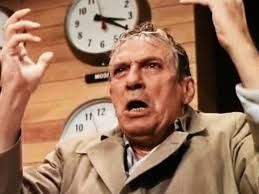
Howard Beale: I want you to go to the window, open it, stick your head out and yell: "I'm as mad as hell, and I'm not going to take this anymore."


Network was very disappointing to me.

Seeing the cast (William Holden, Faye Dunaway, Robert Duvall), and reading the plot, I thought it would be good.  Instead it was tedious.  I will admit that Faye Dunaway was good.  She won Best Actress.  Additionally, Peter Finch won Best Actor and Beatrice Straight won Best Supporting Actress, but they were less memorable in my opinion.

Finch is Howard Beale, a news anchor who has been fired and then says that he's going to kill himself on air during one of his final broadcasts.  Dunaway's character, Diana, a brilliant but cold-hearted executive for the network, takes full advantage of the situation and gets him a regular spot spouting his ranting rhetoric, garnering great ratings for the network.  Holden plays Max Shumacher, a jaded network executive who begins an affair with Diana.  The affair very unsurprisingly goes downhill when the fact that Diana's only real passion is for her job becomes glaringly obvious.  Max heads back to his wife (Beatrice Straight) to appeal to her better nature, telling Diana: "You're television incarnate, Diana.  Indifferent to suffering; insensitive to joy.  All of life is reduced to the common rubble of banality.  War, murder, death are all the same to you as bottles of beer.  And the daily business of life is a corrupt comedy.  You even shatter the sensations of time and space into split seconds and instant replays.  You're madness, Diana.  Virulent madness.  And everything you touch dies with you."

 photo Network3_zps30437c1b.jpg

It's just not that interesting.  The inner workings of a television network are cynical and dull.  Beale's off the cuff, anti-establishment speeches are monotonous.  For example:

"Right now, there is a whole, an entire generation that never knew anything that didn't come out of this tube.  This tube is the gospel, the ultimate revelation; this tube can make or break presidents, popes, prime ministers; this tube is the most awesome goddamn propaganda force in the whole godless world, and woe is us if it ever falls into the hands of the wrong people, and that's why woe is us that Edward George Ruddy died.  Because this company is now in the hands of CCA, the Communications Corporation of America; there's a new chairman of the board, a man called Frank Hackett, sitting in Mr. Ruddy's office on the twentieth floor.  And when the 12th largest company in the world controls the most awesome goddamn propaganda force in the whole godless world, who knows what shit will be peddled for truth on this network?"

It goes on and on.

Once more, I think this is a case of a movie being very modern and edgy when it came out, but no longer packing the same punch today.  I've heard it all before.  Everyone bashes reality TV (while watching it anyway) and decries TV stations as exploitative and money-obsessed.  It's nothing new anymore.