Thursday, December 6, 2012

2002 Chicago

2002 Chicago

"They'd love you a lot more if you were hanged.  You know why?  Because it would sell more papers.  That's Chicago."

"I don't mean to toot my own horn, but if Jesus Christ lived in Chicago today, and he had come to me and he had five thousand dollars, let's just say things would have turned out differently."  

 photo ChicagoAllThatJazz-VelmaKelly_zps02f7d03d.jpg
"All That Jazz" -Velma Kelly
Critics putting this on the worst Oscar winner lists are either musical haters or just plain nuts.  Chicago is the epitome of a musical translated superbly to film.  Arguably the best it has been done.  I'm really hoping Les Miserables gives it a run for its money when it comes out this Christmas (very exciting for me)!

I wasn’t even familiar with the music going in –it was awesome.  The songs were worked in flawlessly, with Roxie Hart (Renee Zellweger) transforming real events into musical numbers in her mind.  The script, the costumes, the actors were all amazing.  Catherine Zeta-Jones (Velma Kelly), Renee Zellweger and Richard Gere (lawyer Billy Flynn) were all Oscar worthy (though only Catherine Zeta-Jones won, they clearly gave Renee Zellweger the award the next year for her role in this and not really for Cold Mountain –no way could she have won for that performance), not to mention wonderful performances by Queen Latifah as Matron "Mama" Morton and John C. Reilly as Roxie's devoted, often ignored husband, Amos.

 photo Chicago2_zps6d892eab.jpg photo Chicago3_zps53d0ff8b.jpg


 photo Chicago4MamaMorton_zps5c0e3bdb.jpgRoxie Hart is an aspiring jazz singer having an affair with a man claiming he can help launch her career.  When he breaks it off with her and reveals that he was lying about his connections, she shoots him dead.  She is put in Murderess' Row, which is under the control of Mama Morton, a woman who is willing to help you out if you've got something to give her in return.  Slick lawyer, Billy Flynn, takes her case, and gives her a new persona to make her into a sympathetic character beloved by the public.  Roxie also gets to know some of the other inmates, including her former idol (now nemesis), Velma Kelly, who shot her husband and sister when she found them in bed together.

 photo Chicago5_zpsb13c1831.jpg

The justice system is portrayed as a circus (Billy Flynn: "It's all a circus, kid.  A three ring circus.  These trials, the whole world, all show business.  But kid, you're working with a star.  The biggest!"), with all the key players acting more like show business people than lawyers or judges:

Billy Flynn: I object!
 photo Chicago6RoxieHartandBillyFlynn_zpsb69b4c93.jpgJudge: Sustained.
Prosecutor: Your Honor, I haven't even asked the question yet.

Roxie's defense is all a sham, based on Billy's expert refashioning of Roxie's image into that of an innocent, put upon woman taken in by the bright lights of the city and by a man she kills only in self-defense (Roxie learns from him, and adds to the charade by pretending to be pregnant).

 photo Chicago7_zps22b9b2a1.jpg

Roxie loves the attention she gets from the trial, but the fickleness of the public is revealed when a new murder takes the public eye away from her right after she is set free, leaving her a nobody again:

Don't you want to take my picture? I'm the famous Roxie Hart. Hey, what happened? Billy, what the hell happened?
Billy Flynn: This is Chicago, kid. You can't beat fresh blood on the walls.
Roxie: But my publicity, Billy. My name in the papers. I was counting on that.

All the publicity is gone in the blink of an eye, and she is back where she started, until she meets up again with Velma, and the two decide to start a double act, which culminates in a great Broadway finish:

 photo Chicago8_zps6093e418.jpgRoxie: It'll never work.
Velma: Why not?
Roxie: Because I hate you.
Velma: There's only one business where that's no problem at all.

The only comparable film that year was Frida, which I also really enjoyed -it's a good example of how a movie can actually be artistic (When people describe Raging Bull as artistic, I am baffled.  I guess it's artistic like throwing a can of paint on a canvas and calling it beautiful is artistic).

 photo Chicago9Frida_zps0a1255d7.jpg

2001 A Beautiful Mind

2001 A Beautiful Mind

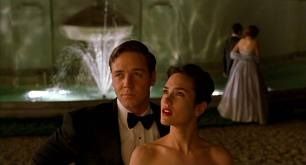
 photo BeautifulMind_zps6ed5dea4.jpg
"Find a truly original idea.  It is the only way I will ever distinguish myself.  It is the only way I will ever matter."

This is quite a change for Russell Crowe, both appearance and performance-wise, from his Oscar-winning role in Gladiator the year before.  From honorable, bulked up warrior Maximus, Crowe has transformed into eclectic, schizophrenic, real-life genius John Nash.  I don't think the characters could be much more different.  Though Russell Crowe was very good in Gladiator, as he is in almost everything, I think he should have won for THIS performance.  He was truly excellent at portraying the complicated Nobel Prize winning mathematician from his college days through his later years, capturing his quirky nature and his mental illness expertly.  His portrayal of Nash is as a charming, but socially stilted man with an increasing paranoia that develops into full-blown schizophrenia.  He talks to himself in public as he tries to solve mathematical quandaries, and has a peculiar jerky walk and twitchy mannerisms.  In one scene, when he is walking on campus as an older man, a student walks behind him imitating his unusual stride, as other students laugh, which really offended me.  I think it is particularly upsetting because it's sadly realistic.  I just read an article today about a video that's gone viral showing a man and his young son both imitating the walk of a ten year old girl with cerebral palsy to mock her.  Infuriatingly wicked and heartless.  How can people be that cruel?  I've gotten off track, but that video is fresh in my mind.

 photo BeautifulMind2MockingNash_zpse2ffdc96.jpg


 photo BeautifulMind3_zps65ea202b.jpgJennifer Connelly plays Nash's wife, Alicia, who loves him in spite of his peculiar, blunt nature (Nash: "I find you attractive.  Your aggressive moves toward me indicate that you feel the same way.  But still, ritual requires that we continue with a number of platonic activities before we have sex.  I am proceeding with these activities, but in point of actual fact, all I really want to do is have intercourse with you as soon as possible.  Are you gonna slap me now?"), and stands by him through his illness (in real life, the two divorce, though they do remarry later in life, but the movie version is more romantic).  Nash later thanks her in his Nobel Prize acceptance speech: "I've made the most important discovery of my life.  It's only in the mysterious equation of love that any logic or reasons can be found.  I'm only here tonight because of you.  You are the only reason I am.  You are all my reasons."

 photo BeautifulMind4_zps61ecf33b.jpg
The movie is originally entirely from Nash's perspective, so his progressing schizophrenia is not apparent, and takes the audience by surprise.  When it switches to Alicia's perspective for a time, we discover that many of the things we've taken for granted in Nash's life are not real.  The college roommate and best friend, Charles (Paul Bettany), and Charles's niece, Marcee, don't exist.  The secret military code breaking he has been doing for a government agent (Ed Harris) is all in his mind.

 photo BeautifulMind5_zpse4e54212.jpg
Doctors try to make Nash realize the truth of his delusions, but he resists.  He takes medications, which make him unable to work or be intimate with his wife.  He goes off the medications and the delusions come back full swing.  He again becomes convinced that his hallucinations are real, and that the doctors were tricking him as part of a plot.  Jennifer Connelly is amazing as Alicia (she won Best Actress for the part), who struggles to stay strong for her husband and deal with his illness.  In particular, the scene where she finally lets all her emotions out, shutting herself in the bathroom to scream and cry and throw things, was really incredible.

 photo BeautifulMind6Ineedtobelievethatsomethingextraordinaryispossible-Alicia_zps01a6e7fb.jpg
"I need to believe that something extraordinary is possible." -Alicia
Finally she can't take it anymore when his behavior leads him to be unsafe around the baby and her, and she runs out of the house to her car in the rain, but at that moment Nash finally has an epiphany that breaks through the fog and makes him realize the truth of his condition: "She never gets old!  Marcee can't be real; she never gets old!"  He decides to work with his illness, instead of curing it.  He accepts that these people he sees are hallucinations, and lives with that realization.  Sometimes they taunt him, sometimes they coax him to acknowledge them.  This is very hard on him at first, especially letting go of Charles and Marcee.  He says goodbye to them, which is hard to watch: "Charles, you've been a very good friend to me.  The best.  But I won't talk to you again.  I just can't.  Same goes for you, baby girl.  Goodbye."  Marcee is crying and he strokes her head before turning his back on them.  Though they stay with him, he can recognize them as false and choose to ignore them: "I've gotten used to ignoring them and I think, as a result, they've kind of given up on me.  I think that's what it's like with all our dreams and our nightmares, Martin, we've got to keep feeding them for them to stay alive."  At the same time, Alicia decides to stay with him and help him to work through his issues instead of sending him to the hospital:

Nash: And then, on the way home, Charles was there again.  Sometimes I miss talking to him.  Maybe Rosen is right.  Maybe I have to think about going back to the hospital.
Alicia: Maybe try again tomorrow.

 photo BeautifulMind7_zpsd3f67517.jpg

By the end, though he still lives with his illness, and knows he always will ("I still see things that are not here.  I just choose not to acknowledge them."), he has a successful life as a professor at the university, with good friends and colleagues that respect his work, as well as his loving family.

It is a good movie, very moving and different, if not really all that close to the true story of Nash's life.  I don't mind a movie improving on the real story to make it happier or more interesting.  I think the actors were the key to this movie.  Aside from the amazing Russell Crowe and Jennifer Connelly, the supporting cast was excellent, with real care given to the casting of the more minor players: Paul Bettany, Ed Harris, Christopher Plummer (his doctor), Josh Lucas, Adam Goldberg, and Anthony Rapp (the last three play colleagues/friends).

Definitely a movie worth watching.

Other movies of the same caliber were Moulin Rouge! (a fantastic, visually fascinating movie), Lord of the Rings: The Fellowship of the Ring (the best of the trilogy in my opinion, though Return of the King won the Oscar, most likely as a tribute to the trilogy as a whole), and Gosford Park (a great British murder mystery that explores the relationships between old time aristocrats and their servants -an idea which the writer of the screenplay, Julian Fellowes, has now expanded into the incredible TV series Downton Abbey.  It was an excellent year for movies.

 photo BeautifulMind8_zps7a8bc7b8.jpg

2000 Gladiator

2000 Gladiator


"Today I saw a slave become more powerful than the Emperor of Rome."

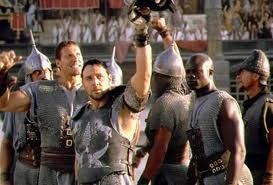
Gladiator was a good movie, but not Braveheart quality as far as period action epics go.  Russell Crowe was the highlight (though I really think he should have gotten his Oscar for A Beautiful Mind the next year -I think most people agree it should have gone to Tom Hanks for Cast Away this year).  Other good movies in 2000 were Erin Brockovich, Chocolat, and Crouching Tiger, Hidden Dragon (all were also nominated).  I guess they are all about on par with each other, and are really good, but not Oscar caliber, movies.  Just one of those years.

Gladiator follows General Maximus Decimus Meridius, "The general who became a slave.  The slave who became a gladiator.  The gladiator who defied an emperor."

Maximus is a popular, successful general in the Roman legion with no greater desire than to return home to his wife and son.

Emperor Marcus Aurelius and Maximus.
Unfortunately for him, he is just too darn good a guy to be spared, which means that Emperor Dumbledore -I mean, Marcus Aurelius -isn't about to let him leave.  Marcus Aurelius is dying, and before he dies he intends to set Rome on a path that will return it to being a Republic.  He does not want his son, Commodus, to become Emperor.  Instead, he wants to leave Maximus in control, so that Maximus can guide Rome during its transition back to a Republic.  Commodus is, let's be honest, a bit of a boob, and Maximus is likeable, honorable, and lacking in political ambition.  He doesn't even want the job, which Marcus Aurelius answers with, "Maximus, that is why it must be you."  The Emperor tells him: "Commodus is not a moral man.  You have known that since you were young.  Commodus cannot rule.  He must not rule.  You're the son that I should have had.  Commodus will accept my decison.  He knows that you command the loyalty of the army."

Wow was he wrong.  I mean, just spectacularly wrong.

Marcus Aurelius makes the boneheaded decision to call Commodus in for a little private conversation to break the bad news that he will not be Emperor.  Does he think to let the Senate know his decision beforehand?  Or the Generals?  Or anybody other than Maximus, so that there is some evidence of his decision other than Maximus's word?  No.  No he does not.  He pretty much leaves Maximus with a "Hey guys, actually he said I get to be in charge...Well no, no he didn't put anything in WRITING, but he really did say so" situation.  To be fair, I guess he didn't quite anticipate just how badly Commodus was going to take the news.

Commodus breaks down in tears, and I almost felt sorry for him, except that I know he's an evil maniac:

"You wrote to me once, listing the four chief virtues: Wisdom, justice, fortitude and temperance.  As I read the list, I knew I had none of them.   But I have other virtues, father. Ambition.  That can be a virtue when it drives us to excel.  Resourcefulness, courage, perhaps not on the battlefield, but there are many forms of courage.  Devotion, to my family and to you.  But none of my virtues were on your list.  Even then it was as if you didn't want me for your son."


Okay, pause to consider: Does he sound to anyone else like a classic Slytherin?  Sorry, but the presence of Richard Harris just put Harry Potter in my mind.  Wikipedia states, "Slytherin house values ambition, cunning, leadership, and resourcefulness."  Hmm?  Hmm?  Also, that they value pure-blood.  Commodus wants to be with his sister (ew), he tells her, because "You will provide me with an heir of pure blood."  Okay, moving on.  I think I've made my point.

Commodus continues in tears: "I search the faces of the gods for ways to please you, to make you proud.  One kind word, one full hug where you pressed me to your chest and held me tight would have been like the sun on my heart for a thousand years.  What is it in me that you hate so much?...All I've ever wanted was to live up to you, Caesar.  Father."

And right here, Marcus Aurelius twists the knife and manages to say the exact wrong thing, which basically signs his own death warrant (How did this man ever succeed as an Emperor?  Talk about a serious case of foot in mouth syndrome, with a side of common sense deficiency.): "Commodus.  Your faults as a son is my failure as a father."  He says this like this is supposed to be comforting somehow...then gives his son a nice "I'm sorry you're worthless, it's my fault" hug.  Can you really blame Commodus for wanting to smother him to death (which he promptly does)?

Commodus quickly pronounces himself Emperor.  In sum, Marcus Aurelius screwed the pooch on this one.


Then it's Maximus's turn to screw himself over.  Commodus tells him, "Your Emperor asks for your loyalty, Maximus.  Take my hand, I only offer it once."  Now, the smart thing to do would be to take his hand, say congrats, get your family to safety, then go meet in secret with the Senators and Generals to gather allies and form a plan.  Sadly, his sense of honor overwhelmed his brain temporarily.  Knowing that Commodus murdered Marcus Aurelius, he refuses to take his hand, and storms off.  Again, in his defense, I doubt he suspected exactly how cruelly Commodus would react.  Commodus not only orders Praetorians (soldiers) to take Maximus out and have him killed, he also gives an order to have Maximus's wife and son crucified.  This is pretty evil of Commodus.  What is the point of painfully murdering Maximus's family other than to be sadistic?  Maximus is an incredible fighter and escapes, though he is injured, but does not make it home in time to save his family, and collapses from anguish and from the pain of his wounds.

"Are you not entertained?"

When he wakes up, he has been taken into slavery.  Apparently, back in the day, if you found someone lying injured on the road, it was kind of a finders keepers sort of deal.  He is purchased by Proximo, an ex-gladiator who now owns gladiators.  Maximus pretty quickly establishes himself as an awesome gladiator known as The Spaniard, befriends his fellow gladiators, and is taken under the wing of Proximo, who advises him: "Listen to me.  Learn from me.  I was not the best because I killed quickly.  I was the best because the crowd loved me.  Win the crowd and you will win your freedom."

Commodus meeting with the Senate.
In Rome, Commodus, it is quickly apparent, is shaping up to be one of the craziest, crappiest Emperors imaginable.  He has no interest in dealing with the issues at hand; rather, he is concerned with gaining the love of the people so that he can abolish the Senate (Now this is starting to seem a little bit Star Wars-esque...Emperor Palpatine, anyone?  Remember "The Imperial Senate will no longer be of any concern to us.  I have just received word that the Emperor has dissolved the council permanently.   The last remnants of the Old Republic have been swept away forever."?).  In order to gain the love of the people, Commodus decides to hold a series of games and festivities.  Senator Gracchus is rightly concerned with this clever tactic, saying, "I think he knows what Rome is.  Rome is the mob.  Conjure magic for them and they'll be distracted.  Take away their freedom and still they'll roar.  The beating heart of Rome is not the marble of the Senate, it's the sand of the Coliseum.  He'll bring them death -and they will love him for it."  When he's not busy plotting the downfall of the Senate, Commodus is mooning after his sister, Lucilla, which creeps her out, not to mention me.


Proximo brings his troupe of gladiators, including Maximus, to Rome for the festivities.  His men are sent into the arena to act as the barbarians in a reenactment of the Battle of Carthage, which means they are presumably being sent to their death; however, Maximus is a brilliant military strategist, and rallies the other gladiators: "Anyone here been in the army?  You can help me.  Whatever comes out of these gates, we've got a better chance of survival if we work together.  Do you understand?  If we stay together we survive."  In a wonderful coupe, his gladiators win the fight.  Commodus observes to the master of ceremonies, "My history's a little hazy Cassius, but shouldn't the Barbarians lose the battle of Carthage?"

Commodus strides out to meet the famous Spaniard, and asks his name:

Maximus: My name is Gladiator.
Commodus: How dare you show your back to me!  Slave, you will remove your helmet and tell me your name.
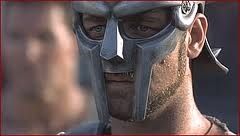
Maximus: My name is Maximus Decimus Meridius, commander of the Armies of the North, General of the Felix Legions, loyal servant to the true Emperor, Marcus Aurelius.  Father to a murdered son, husband to a murdered wife.  And I will have my vengeance, in this life or the next.

Shocked to discover Maximus alive, Commodus wants to have him slain; however, the crowd loves Maximus, and screams for him to live.  As Commodus is hosting these games for the purpose of winning favor with the people, he is forced to concede.


His sister, Lucilla, a lovely widow with a charming eight year old son, Lucius, sneaks out to meet with Maximus.  They had had some sort of relationship in the past, and it's clear she still loves him.  She is a likeable, strong character.  Her father had told her before he was killed, "If only you had been born a man, what a Caesar you would have made," and it is clearly true.  She is politically adroit, level-headed, clever, and brave.  Since her brother took power, she has "been living in a prison of fear since that day," afraid of her brother killing her son if she does not toe the line, and afraid because he is clearly sexually interested in her, which naturally repulses her.  Now she wants to help Maximus escape so that he can retake control of his army, defeat Commodus, and restore the Senate to power in order to return Rome to a Republic as her father wished.  She and Senator Gracchus have a plan to make this happen, but it is foiled when Commodus discovers the plot.

Now feeling betrayed by Lucilla, who he professes to love more than anyone, Commodus is more bloodthirsty than ever.  Lucilla is his prisoner, threatened with the murder of her son if she doesn't do exactly what he says, or if she tries to commit suicide.  He has decided to stage a fight between himself and Maximus in the arena.  Of course, he's a coward, and doesn't intend to lose, so he stabs Maximus beforehand, then has them put Maximus's armor on so that no one can tell that he has been mortally wounded.

This time Commodus has underestimated his foe, however, and even in his dying daze, Maximus manages to kill Commodus.  Nobody seems to care much.  The Senators and soldiers seem pretty relieved by the whole thing.  When Maximus collapses and dies from his injury, Lucilla says: "Is Rome worth one good man's life?  We believed it once.  Make us believe it again.  He was a soldier of Rome.  Honor him."  And they all pick him up and carry him out.  Commodus is left there like a piece of trash, which, let's face it, he was.


"Go to them."
Though the scene is quite moving, with beautiful images of Maximus being reunited with his family in heaven, set to beautiful music, interspersed with the implications that a better day is dawning for Rome, I couldn't help putting myself in the place of one of the many people in the audience at the Coliseum.  It has to have been one of the most confusing, awkward ends to a sporting event they've ever witnessed.  It's a sunny day, they've bought their tickets, taken the kids out for a nice day at the Coliseum for some kebobs and some bloodshed...They don't really know the back-story and can't hear what the people are saying down in the arena.  They just know that the Emperor and his competitor have both been killed.  If you look up in the stands, they're all kind of speechless, like, "Uh, what do we do now?  Are we supposed to cheer?  Cry?  Should we all just quietly shuffle out?"  Try to picture it: You've gone to your local arena to watch a boxing match to see your favorite boxer.  To your surprise, President Obama steps out in little shorts and a robe, and...what's that?  Boxing gloves?  They fight, and the President is killed, and lo and behold, his opponent is down too.  Out come some Senators and Michelle Obama and some Secret Service guys, and they all carry the opponent off to honor him, leaving the President behind.  Would this not be confusing?

Emperor Commodus is the guy on the floor.

Anyway, it is a good movie, though, as Tyler says, a bit melodramatic (ex. Marcus Aurelius: "There was a dream that was Rome.  You could only whisper it.  Anything more than a whisper and it would vanish, it was so fragile.").  A little much.  Russell Crowe can pull it off and sound good, but some of the others not so much.

Worth watching, but not an Oscar winner in my mind.

The Colisum today.

Not really important, but I should mention the lack of historical accuracy here.  In fact, the succession issue seems to have been the opposite of how it was portrayed in the movie, according to Wikipedia: "Marcus gave the succession to his son Commodus, whom he had named Caesar in 166 and made co-emperor in 177.  This decision, putting an end to the series of "adoptive emperors", was highly criticized by later historians since Commodus was a political and military outsider."  The article does go on to describe Commodus as "an extreme egotist with neurotic problems," so at least that part was true.  And he apparently did like to appear in the arena as a gladiator, and "always won since his opponents always submitted to the emperor," and he was assassinated, though not by Maximus (he is a fictional character).  Lucilla was really his sister, and was executed for conspiring to have him assassinated.  This particular conspiracy (it seems there were many -Commodus's mistress also tried to poison him), totally failed, because it seems the chosen assassin had been watching too many plays, and thought he needed to deliver a good pre-assassination zinger: "As he burst forth from his hiding place to commit the deed, Quintianus’ nephew boasted to Commodus "Here is what the Senate sends to you", giving away his intentions before he had the chance to act.  Commodus's guards were faster than Quintianus, and the would-be assassin was overpowered and disarmed without injuring the emperor."

1999 American Beauty

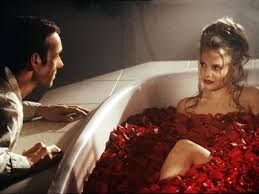
 photo AmericanBeautyLesterfantasizingaboutAngela_zpse61f935b.jpg
Lester fantasizing about Angela.
1999 American Beauty

"Remember those posters that said, "Today is the first day of the rest of your life"?  Well, that's true of every day but one -the day you die."

This is a movie about a group of highly dysfunctional people.  Mostly over-indulged, self-centered, angry people.  There's Lester Burnham (Kevin Spacey), the narrator, who is unhappy with his life and has become quite unhinged and hostile, and fantasizes about his daughter's underage friend, Angela: "I feel like I've been in a coma for the past twenty years.  And I'm just now waking up."  Angela is a damaged girl so worried about being "ordinary" that she overcompensates by bragging about nonexistent sexual encounters.  There's Lester's wife, Carolyn (Annette Benning), a neurotic, uptight mess, also unhappy with her life, which leads her to an affair with a fellow realtor: "My company sells an image.  It's part of my job to live that image."  Then there's their daughter, Jane, with body-image issues and parent-loathing issues, who is, you guessed it, also unhappy with her life, and starts dating her bizarre next-door neighbor.  They all have lots of anger and misery in spite of their privileged existences.  It's hard to feel sorry for them (except maybe for Jane, since her parents are a mess, though she has too much of an attitude to garner much sympathy), because they are in charge of their own lives.  They can change things whenever they want (and not in the way that Lester does, becoming volatile and wacky).  They can quit their jobs, move, divorce, find happiness.  You've been in a coma for 20 years, Lester?  Why has it taken you 20 years to figure out you need to change something in your life?

"See the way the handle
on her pruning shears
matches her gardening clogs?
That's not an accident."
-Lester describing Carolyn.

The next door neighbors are just as messed-up.  Jane's boyfriend, Ricky, is a camera-obsessed drug dealer who thinks he's very profound, filming dead birds and plastic bags and spouting philosophies that probably only sound good if you're actually high on some of his drugs.  He's been pretty abused by his regimented, violent father, Frank (Chris Cooper), who rants about how disgusted he is about homosexuals, and then turns out to have homosexual feelings of his own that apparently cause him a lot of confusion and self-hatred.  His wife is near-catatonic, so we never learn much about her.
All these characters come together, and the mystery is, since we know from the beginning that Lester will die at the end (very Sunset Boulevard), who will kill him and how will it happen?

The movie is full of fantastic performances, especially from Kevin Spacey and Annette Benning, with sharp and witty dialogue, and it does keep your interest, but it's not Best Picture worthy in my opinion.  It takes itself too seriously, and is too pretentious and self-adulating for my taste.  It's not as deep as it thinks it is.

At least now we know the sordid truth: suburbia is a crazy place full of crazy, repressed, miserable people.  Such a novel idea.  Seriously, these writers must have lived in some pretty interesting neighborhoods to have this kind of impression of the suburban lifestyle.

 photo AmericanBeauty3_zps2c63146f.jpg

I would sooner have given the award to The Sixth Sense (a terrifying, original, beautiful horror film full of twists) or The Matrix (an awesome sci-fi film if you can pretend the sequels don't exist).  Both are movies with unique story ideas (what a concept) and absolutely no strange floating rose petals.

 photo AmericanBeauty4TheSixthSense_zpsd9d5b582.jpg
The Sixth Sense.
Cole Sear: I see dead people...Walking around like regular people.  They don't see each other.  They only see what they want to see.  They don't know they're dead.
Malcolm Crowe: How often do you see them?
Cole: Sear: All the time.  They're everywhere...You ever feel the prickly things on the back of your neck?...And the tiny hairs on your arm, you know when they stand up?  That's them.  When they get mad...it gets cold.

 -The Sixth Sense

Boy: Do not try and bend the spoon.  That's impossible.  Instead... only try to realize the truth.
Neo: What truth?
Boy: There is no spoon.

-The Matrix
 photo AmericanBeauty5TheMatrix_zpscceeb740.jpg
The Matrix.

Wednesday, December 5, 2012

1998 Shakespeare in Love vs. Saving Private Ryan

1998 Shakespeare in Love

"The Master of the Revels despises us all for vagrants and peddlers of bombast.  But my father, James Burbage, had the first license to make a company of players from Her Majesty, and he drew from poets the literature of the age.  We must show them that we are men of parts.  Will Shakespeare has a play.  I have a theatre.  The Curtain is yours."

A great film, and one I love to watch, with humor, sorrow, terrific dialogue, and wonderful performances.

It's a fictionalized portrayal of William Shakespeare (Joseph Fiennes) writing Romeo and Juliet, inspired by his relationship with Viola (Gwyneth Paltrow), a wealthy woman pretending to be a boy in order to act in his play (only men could appear on the stage at that time).

It is very romantic, with a tragic ending, paralleling Romeo and Juliet in various ways (Not quite such a traumatic ending, but they are parted forever, Shakespeare telling Viola tearfully, "You will never age for me, nor fade, nor die.").  In fact, this is the only time I have actually enjoyed any sort of rendition of Romeo and Juliet.

The supporting cast (Geoffrey Rush, Colin Firth, Judi Dench as Elizabeth I, Ben Affleck, Tom Wilkinson, and Rupert Everett) really add to the movie.

This is the sort of movie that I not only own, but have watched repeatedly.

BUT, let's face it: Saving Private Ryan should have won.

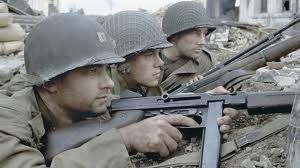
1998 Saving Private Ryan

"You wanna explain the math of this to me?  I mean, where's the sense of riskin' the lives of the eight of us to save one guy?"

"Tell her that when you found me I was here and I was with the only brothers that I have left and that there was no way I was gonna desert them.  I think she'll understand that.  There's no way I'm leaving this bridge."


It should have won.  We all know it.  It changed the face of war movies.  Tyler  described it to me as an extremely accurate depiction of war.  Based on his emotional reaction to the movie as a combat veteran, I think it accomplishes something honest and real that is deserving of the Oscar.

Life is Beautiful was another great choice this year, both charmingly funny and devastatingly sad as a father (Roberto Benigni) uses pluck and humor to keep up his son's courage and save his life while hiding him from the Nazis in a concentration camp:

Guido [Getting packed into the train to the concentration camp]: You've never ridden on a train, have you?  They're fantastic!  Everybody stands up, close together, and there are no seats!
Giosué Orefice: There aren't any seats?
Guido: Seats?  On a train?  It's obvious you've never ridden one before!  No, everybody's packed in, standing up.  Look at this line to get on!  Hey, we've got tickets, save room for us!

Another feast or famine situation.  I suppose there are worse things than having three Oscar-worth movies to choose from in a year.

A good rule of thumb: When in doubt, go with Steven Spielberg.

Tyler has agreed, as the person I know most capable of truly reviewing Saving Private Ryan, to provide a guest review.  Enjoy the magnificent writing of my talented husband:

Saving Private Ryan Guest Review

Written by Tyler Smith

Saving Private Ryan was released in 1998 and is, in my opinion, the most realistic war movie ever made.  It was also the first movie to show what war is actually like and not romanticize it at all.  It opens in modern day Normandy with a veteran walking near the battlefield with his children and grandchildren.  He walks to a grave and kneels beside it in tears remembering the events in his life that had occurred 54 years previous.  The movie does not tell you who this man is but you assume it is Tom Hanks’s character because in the next scene it shows a close up of his face while he is in a Higgins landing craft being ferried to Omaha beach.


It is at this point that the movie kicks the viewers right in the teeth.  As the ramp drops on the landing craft the carnage begins, and I mean carnage.  I have been in combat and I can say that the only thing missing from the beach scene is the smell.  I guess it would need to be much louder, but watching it you get the point.  Things are very confused on the beach but eventually Tom Hanks manages to breach the German (Actually the soldiers defending this stretch of beach were Czechoslovakians) lines.  This scene left me feeling worn out and disgusted when I first saw it.  It was war, real and pure, with no glory or heroes, only shell shocked survivors.

At this point the movie shifts and begins to pose the main question: What is the life of one man worth?  Hanks is asked to pick a team of 8 soldiers to go deep behind German lines and find a single paratrooper who has lost all of his brothers to the war, all killed within a couple weeks.  Back story for the mission, there were five brothers with the last name of Sullivian who all joined the navy and wanted to be on the same ship.  They were allowed to serve together but when their ship was sunk and they were all killed it was decided that family members would not be allowed to serve in the same units together, for fear of the war wiping entire families away in single afternoons like had happened to the Sullivian brothers, and if there were multiple deaths in one family the sole survivor would be brought home ASAP.

The team is only given a name and a vague possible location.  Along the way they lose two men KIA and tensions run high, finally boiling over when a German is captured after a sharp firefight.  Here Tom Hanks reveals what his profession was in the US, a question that has been the subject of a pool among Hanks’s soldiers.   They decide to let the German go and not take revenge for their fallen Medic.  They decide that killing the German will not help them in their quest and they let him walk off unarmed.


Eventually they find Private Ryan as part of an ambush team and tell him about their mission.  He thinks it is a dumb idea, sending 8 men to find and retrieve one.  He does not feel that his life was worth those of the men that were lost trying to find him and refuses to leave his unit before a critical battle to hold a bridge.  Hanks agrees to stay with the beleaguered Airborne to help defend the bridge, but immediately afterwards plans to return to his unit with Ryan in tow.

What followed was a brutal, desperate, disturbing battle of survival in which darn near everyone gets killed.  The Americans hold the bridge but Hanks is killed (shot by the prisoner he earlier released).  Ryan survives the ordeal and becomes the old man that the film begins with.

As I stated earlier, the central question in this movie is: What is the life of one man worth?  You see dozens of men violently killed to the point where you are convinced that if put in a similar situation, your life span would be reduced to minutes if not seconds, yet Hanks’s team goes to titanic efforts to save one among hundreds of thousands.   I think the answer is one man’s life is priceless, but war is a bloodthirsty, rampaging, uncontrollable beast destroying all it touches and while we believe life to be endlessly precious, war cares not.

Tuesday, December 4, 2012

1997 Titanic vs. Amistad

1997 Titanic

"Fifteen-hundred people went into the sea, when Titanic sank from under us.  There were twenty boats floating nearby, and only one came back.  One.  Six were saved from the water, myself included.  Six out of fifteen-hundred.  Afterward, the seven-hundred people in the boats had nothing to do but wait.  Wait to die.  Wait to live  Wait for an absolution that would never come."

At the time James Cameron's Titanic was made, there was no way it was not going to win the Oscar.  It was revolutionary in scope.  The technology was incredible -the recreation of the ship, the sinking...It was produced on such a grand scale that it awed everyone and was a shoe in for Best Picture.  I'll admit I saw it more than once in the theater.

Now that time has gone by, the visual effects are still impressive, but no longer astounding now that other movies have caught up.

Once the effects are stripped away, and the script and acting are laid bare, the movie is not that great.  It's still good, but not great.

The story isn't especially original.  Kate Winslet's Rose is unhappy with her life.  She leads a privileged life, but feels trapped, and is being forced to marry a rich man against her inclinations.  I found it a little hard to sympathize.  Her life is not that bad ("I saw my whole life as if I'd already lived it.  An endless parade of parties and cotillions, yachts and polo matches.  Always the same narrow people, the same mindless chatter."  Yeah, it sounds just awful.).  And though under enormous pressure from her mother to marry Hal, she does have the option to just say no and do something else with her life.
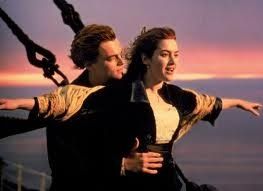
"I'm flying, Jack!" -A scene often parodied.
Rose falls in love with Leonardo DiCaprio's Jack, a poor young artist.  Sadly, their love seems to distract the look-outs, who maybe could have seen the iceberg ahead if they hadn't been watching the two young lovers make out below.  Now we know the truth: The sinking of the RMS Titanic was the fault of Rose and Jack.

The acting is a little melodramatic, and the lines seem a tad cheesy now -maybe because they've been spoofed so often: Think: "I'm the king of the world!"

The cinematography, the effects, the costumes -all these are still exceptional, but the acting isn't out of this world, the plot isn't especially inspired, and script is lacking.

I preferred As Good as It Gets (A romantic comedy/drama with perfect performances by Jack Nicholson, Helen Hunt, Greg Kinnear, Cuba Gooding Jr., and a terrific script) and The Full Monty (hilarious).

As Good as it Gets.
Melvin Udal (Jack Nicholson): "I might be the only person on the face of the earth that knows you're the greatest woman on earth.  I might be the only one who appreciates how amazing you are in every single thing that you do, and how you are with Spencer, "Spence," and in every single thought that you have, and how you say what you mean, and how you almost always mean something that's all about being straight and good.  I think most people miss that about you, and I watch them, wondering how they can watch you bring their food, and clear their tables and never get that they just met the greatest woman alive.  And the fact that I get it makes me feel good, about me." -As Good as It Gets

Compare this to Jack's juvenile wooing in Titanic:
"Rose, you're no picnic, all right?  You're a spoiled little brat, even, but under that, you're the most amazingly, astounding, wonderful girl, woman that I've ever known...No, let me try and get this out.  You're ama- I'm not an idiot, I know how the world works.  I've got ten bucks in my pocket, I have no-nothing to offer you and I know that. I understand.  But I'm too involved now. You jump, I jump remember?"  Not overly inspired dialogue.  

Dave: "We may not be young, we may not be pretty, we may not be right good.  But we're here, we're live, and for one night only, we're going for he full monty!" -The Full Monty

The Full Monty.
But the movie that I think should have won the Oscar is Amistad.

1997 Amistad

John Quincy Adams: Now, you understand you're going to the Supreme Court.  Do you know why?
Ens. Covey translating for Cinque: It is the place where they finally kill us.


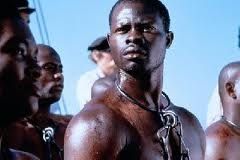
Cinque.
Steven Spielberg's Amistad is an all around excellent movie without relying on special effects to make it great.  It is a story of morality and justice that stands the test of time.  It's a powerful, with amazing actors and a terrific script.

The story revolves around a group of Africans captured by the Spanish in West Africa (an illegal practice -the Spanish slavers try to claim that they were obtained from Havana).  These Africans manage, after being kept in atrocious, horrifyingly brutal conditions, to take over the ship, La Amistad.  When Rose from Titanic says, "It was the ship of dreams to everyone else.  To me it was a slave ship, taking me back to America in chains.  Outwardly, I was everything a well brought up girl should be.  Inside, I was screaming," she wouldn't have gotten much sympathy from these people.  It made me want to smack her.  A slave ship?  Yeah.  Try watching a group of people get thrown overboard tied to an anchor, and then you can complain about your first class cabin:

On board La Amistad vs. Rose handing paintings in her stateroom.

Baldwin: Cinque describes the cold-blooded murder of a significant portion of the people on board the Tecora.  Mr Holabird sees this as a paradox.  Do you, sir?
Captain Fitzgerald: Often when slavers are intercepted, or believe they may be, they simply throw all their prisoners over board and thereby rid themselves of the evidence of their crime.
Baldwin: Drown hundreds of people?
Captain Fitzgerald: Yes.
Holabaird: It hardly seems a lucrative business to me, this slave trading.  Going to all that trouble, rounding everybody up, only to throw them all overboard.
Captain Fitzgerald: No, its very lucrative.
Baldwin: If only we could corroborate Cinque's story somehow with evidence of some kind.
Captain Fitzgerald: The inventory.  If you look, there's a notation made on May tenth, correcting the number of slaves on board, reducing their number by fifty.
Baldwin: What does that mean?
Captain Fitzgerald: Well, if you look at it in conjunction with Cinque's testimony, I would say that it means this: The Tecora crew have greatly underestimated the amount of provisions required for their journey, and solved the problem by throwing fifty people overboard.
Holabaird: I am looking at the same inventory, Captain, and I am sorry, I don't see where it says, 'Today we threw fifty slaves overboard', on May tenth or any other day.
Captain Fitzgerald: As, of course, you would not.
Holabaird: I do see that the cargo weight changed.  They reduced the poundage, I see.  But that is all.
Captain Fitzgerald: It's simple, ghastly arithmetic.
Holabaird: Well, for you, perhaps.  I may need a quill and parchment, and a better imagination.
Captain Fitzgerald: And what poundage do you imagine the entry may refer to, Sir?  A mast and sails perhaps?
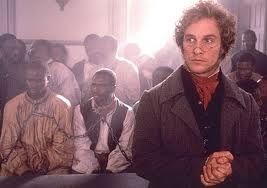
Baldwin.
The unofficial leader of the group, Cinque (Djimon Hounsou), tries to get a couple of captured Spanish sailors to direct them back to Africa, but they guide them to the United States instead, where they are captured.  The rest of the story is about the trials determining who the African men "belong" to.  Different people are vying for possession, while representatives for the African men (Baldwin, a property lawyer, played by Matthew McConaughey, and a free former slave named Theodore Joadson, played by Morgan Freeman) insist that they were illegally captured from Africa and should therefore be returned home.

It is a fascinating courtroom drama, as well as a graphic depiction of the brutality of the slave trade, and a triumphant picture of men willing to fight for freedom whatever the cost.
Matthew McConaughey is great in a part less glamorous than his usual roles.  Djimon Hounsou gives an intense performance, standing up in court and demanding "Give us, us free.  Give us, us free," in faltering English but an unwaveringly powerful voice.  Morgan Freeman, Anthony Hopkins (as John Quincy Adams), Jeremy Northam (Judge Coglin), Peter Firth (Captain Fitzgerald), Razaaq Adoti (Yamba), and many of the other supporting actors were also admirable.

A really exceptional movie that stays with you.

Saturday, December 1, 2012

Wings and The Broadway Melody Re-Reviewed

Though I didn't really want to, I thought I'd better re-watch Wings and The Broadway Melody.  My reviews were bare-boned because I couldn't remember much about these movies, having seen them so long ago.

Wings 1927-1928


Wings was actually quite a bit better than I remembered.  It's about two pilots during WWI, Jack Powell and David Armstrong, and their love quadrangle.

Jack and David both love a gal named Sylvia.  Sylvia loves David, but Jack mistakenly thinks she loves him.  Meanwhile, Jack's long-time next-door neighbor, Mary Preston (Clara Bow -she was great), loves Jack.  With this situation established, Jack and David head off to aviator school and then off to fight the Germans.

They get in a bit of a scuffle, and then decide they like each other despite loving the same gal, and quickly become best friends.
David is shot down by Jack.
Especially considering when it was made, it has really excellent battle scenes and air battles.  David and Jack are both very likeable guys, and we see them go from rookie pilots to aces over time.  They deal with the stresses of war and form a close bond.

David dies in Jack's arms.
Unfortunate circumstances lead to David's death when he tries to get back from across enemy lines by stealing a German plane, and Jack shoots him down not realizing it's him.  He is racked with guilt, but David reassures him before he dies that it wasn't his fault.  Jack fulfills his promise to David to return David's things to his parents.  He breaks down crying when he sees them, and ends up crying in the lap of David's mother.  She says she wanted to hate him, but she can't, and that she realizes it wasn't his fault.


Jack reads letters from Sylvia to David after his death, and sees that she loved David all along.  David hadn't said anything because he didn't want to break Jack's heart.

Clara Bow as Mary.
Jack realizes that he really loves Mary, and they finally get together.  Poor Sylvia is left to mourn.

The actors are really good, and the movie is surprisingly still relevant.


The Broadway Melody 1928-1929

I still didn't like The Broadway Melody.  It should be called Two Loving Sisters and the Schmuck Who Got Between Them.

Hank and Queenie are a performing sister act that move to New York -to perform on Broadway and so that Hank can be with her longtime love, Eddie.

Hank and Queenie.
Eddie hasn't seen Queenie since she was a kid.  He is very excited about seeing Hank, and looking forward to marrying her, until he sees Queenie.  Lo and behold, she has grown up and now she's the bombshell of the two.  Within seconds his affections have switched from Hank to Queenie.  Queenie picks up on this (he's not exactly subtle), and because she loves Hank so much, she tries to get herself out of the picture so as not to get between Hank and Eddie.  She even starts seeing a sleazy guy to divert attention from the chemistry between Eddie and herself.  Hank doesn't understand why she is acting so distant and peculiar, and tries to get Queenie to stop going out with the sleazy guy and spend time with her and Eddie instead (a different sleazy guy), and is upset when Queenie becomes hostile and refuses.

Eddie pursuing Queenie.
This goes on, with Eddie pursuing Queenie, Queenie trying to rebuff him despite her inexplicable secret love for him, and Eddie pretending he still loves Hank, who is broken-hearted about the distance that has come between her and her beloved sister.  When Hank figures out that Eddie and Queenie are in love, she gallantly steps aside so that they can marry, pretending that she never really loved Eddie after all.  There is a scene where she is sobbing in her dressing room after telling Eddie she never cared about him and sending him to go to Queenie that was really depressing.  Both gals are so nice and so self-sacrificing, and they both care so much for each other, that it just really stinks to see this worthless guy come between them.  And it's plain to see that as soon as Queenie gets a little older and isn't the young starlet anymore he'll move on to another gal without missing a beat.  Ugh.