Saturday, October 6, 2012

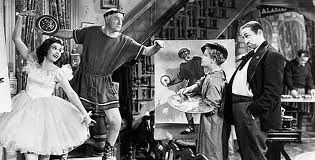
1938 You Can't Take it With You

1938 You Can't Take it With You

After starting this one, I quickly realized that I had seen it before!  And after waiting all this time for it to arrive.

I can't say it's my sort of movie.  It's a little chaotic and hectic for my taste.

It's about two characters, Alice Sycamore and Tony Kirby, and their families.  Tony is from a rich family and is vice president at his family's company, and Alice is his secretary.  The two are in love and talking marriage, so they decide their families need to meet.  Coincidentally, Alice's grandfather is the one holdout in an important neighborhood buyout project of Tony's father (he needs to convince him to sell, or his plan to build a factory is ruined).

The main point of the movie is that people should follow their dreams, pursue their interests, and not worry about money.  I was just listening to a segment on the radio the other day making the same argument, and though a nice idea, it's not very realistic.  I think you should like your job, but sometimes your interests just don't pay, and when you've got kids to support, and a mortgage to pay...but then, that's not a very romantic perspective.

The ideal, I guess, is supposed to be the life of the bohemian Sycamores -prancing around their house like loonies, dancing, setting off firecrackers, inventing nonsense, and just loving every eccentric thing they do.  Personally, I felt exhausted just watching them and all their hootenannies.  They seem like a bunch of lunatics.  The Kirbys are the extreme opposite -snobbish and only concerned about money.  I think the real ideal is somewhere between the two.  Enjoying your life while also taking care of your responsibilities, and trying to act at least the tiniest bit sane.

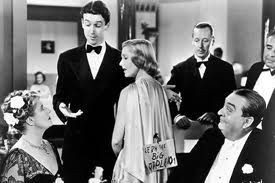
Jimmy Stewart is the highlight of the movie, showing his comical side.  In one scene, he tells Alice not to worry about his parents accepting their relationship, because he has always been able to scream and get what he wants ever since he was a baby.  He then proceeds to let out a couple of really impressive screams, terrifying an office worker.  That gave me quite a laugh.

Not really one of my favorite winners.

Friday, October 5, 2012

1932-1933 Cavalcade

 photo Cavalcade_zps5ce914b5.jpg1932-1933 Cavalcade

I finally got a copy of this movie!  It earns an honorable mention for being the one and only best picture winner NOT available on DVD.  I ended up getting a used VHS from Amazon.  I doubt I will be watching it again, so some lucky person may get to pick it up at Half Price Books for a really great bargain.

Cavalcade starts out pretty entertaining, taking a bit of an Upstairs/Downstairs sort of approach by following two families: the aristocratic Marryots upstairs, and the downstairs servants, the Bridges.

Watching their husbands depart.
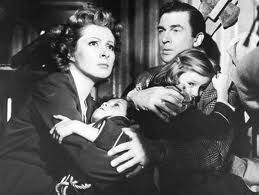
The movie begins on New Year's Eve, 1899.  Lady Marryot is preparing for the departure of her husband.  He is leaving to fight in the Boer War, and Mr. Bridges is going with him, leaving Mrs. Bridges and Lady Marryot nervous wrecks.  The most powerful scene in the movie is when Lady Marryot is saying goodbye to her husband as he is about to board his ship and set off for Africa.  He tells her to give him one more kiss, then to turn around and keep talking, which she does, rambling on as if he is still there, until she turns and breaks down watching the ship sail away.  It was so hard for me to watch, being able to put myself in her place.  I could easily picture what a wreck I would be if Tyler were going off to war and I was kissing him goodbye, knowing it could be the last time I saw him.  She doesn't quite show the stiff upper lip of Mrs. Miniver, being pretty much an emotional mess the whole time he is away, but I could relate more to her than to Mrs. Miniver.

Fortunately, her husband and Mr. Bridges both return safely, and Mr. Bridges and his family leave to start running a pub.  Unfortunately, that is pretty much the last good news for Lady Marryot.  Her eldest son falls in love with the daughter of her best friend, and the two wed.  We see them on their honeymoon on the deck of a ship, talking about how happy they are.  His new bride says that she doesn't think she would mind dying, because she will never be any happier than she is that moment, and that she fears their love will fade over time.  I guess be careful what you wish for, because when they move aside, the life preserver on the deck bears the word "Titanic."  That sure took me by surprise.  The son dies, and we never find out if his wife died as well.

Then on to WWI, and of course her other son joins the army.  He has an affair with the Fanny Bridge (daughter of Mr. and Mrs. Bridge), who has become a singer, and he wants to marry her; unfortunately, he is killed right before the Armistice.  Lady Marryot has lost both her sons, has no grandchildren...she walks the streets during the huge Armistice celebration just looking shocked and sick to her stomach.

Mr. Bridges becomes a drunk and gets killed when he is run over by a carriage.  What else?  We never really find out what happens to Fanny.  I guess she goes on singing.

It ends with another New Year's Eve some years later, with Lady Marryot and her husband having a toast to the future by themselves.  Talk about depressing.

The movie is fond of the montage (we get to see WWI through this mechanism), and of a strange shot of people riding on horses that is randomly shown whenever the story takes a leap forward in time.  There are also several musical numbers that don't really move the plot at all or feel in any way necessary.  The actress that plays Fanny is melodramatic and annoying.  The heart of the movie is definitely in Lady Marryot.  The actress really captures the fear of saying goodbye to loved ones and the devastation of loss.

Not one of the better best picture winners overall.

1943 Casablanca

1943 Casablanca

I just re-watched this movie, after only having seen it once when I was little.  It didn't make much of an impression on me the first time, and I decided not to write a review based on that experience (especially considering how terrible a review I would have given Gone With the Wind if I had based it only on my childhood impressions).

 photo Casablanca_zps252c6370.jpg
I really enjoyed seeing it again.  It all made so much more sense to me.  The circumstances and politics (not to mention the complicated relationships) made so much more sense this time around.

Really a classic movie.  It is packed full of famous lines.  As mentioned, I had only seen it once years ago, but I still knew practically all the lines in the last scene.  That's the sign of a pretty amazing script.
  
The plot revolves around Rick, a bar owner in Casablanca, a part of Vichy Occupied France in Morocco.  He is minding his own business, keeping his hands clean while WWII rages, when lost love Ilsa arrives with her husband, Victor Laszlo, an important Czech leader on the run from the Germans.  Rick and Ilsa had been in love in Paris before the Occupation, and had planned to run away together.  Instead, she sent a note to meet him at the train, saying she wasn't coming and not much more.  Rick is understandably angry, and still clearly hung up on her, despite holding a nasty grudge.

He has become bitter and cynical, and only looks out for himself.  Even though he has the ability to help get Ilsa and her husband out of Casablanca, he is resentful and refuses to be of any assistance.  Ilsa finally gets him to listen to her story, and explains that she had married Victor before she had met Rick, out of a sense of admiration and respect rather than true love.  She had fallen in love with Rick after being told that Victor had died.  Though Rick is the man she truly loves, when she found out that Victor was alive, near Paris, and ill, she returned to him out of loyalty.  She says she doesn't have the strength to leave Rick again, and he agrees to help get Victor out of the Casablanca, while she plans to stay behind with Rick.

 photo Casablanca2_zps38d9460c.jpg

At the last minute, Rick famously tells her that he is sending her with Victor: "Inside of us, we both know you belong with Victor. You're part of his work, the thing that keeps him going.  If that plane leaves the ground and you're not with him, you'll regret it. Maybe not today. Maybe not tomorrow, but soon and for the rest of your life."

In my opinion, she should have stayed with Rick.  Life's too short and love too precious to be wasted.

All the acting was great, and I particularly liked Claude Rains as Louis Renault, a shady character who ultimately does the right thing.  My favorite scene was probably when the Germans were singing a German soldier song, and Laszlo gets the others in the bar to drown them out with the French National Anthem.  A bit reminiscent of the UW marching band drowning out USC's incessant playing of Conquest! in 1991.  If you've ever been to a USC game and heard how many times they play that song, you'll understand why this was so important (and why the band was named MVP of the game).  I digress!

Anyway, a really great movie, and I'm glad I watched it again to have the opportunity to really appreciate it.

Thursday, October 4, 2012

Spoiler Alert


Tyler mentioned to me yesterday that I should put a "spoiler alert" warning before giving away movie endings and key points.

The truth is, I don't want to have to write that in every post, so here is a general spoiler alert:

I will be giving away major plot points and sometimes flat out giving away the movie endings. 

I avoid it if I can (I didn't say what Rosebud means, did I?  Tyler says everyone already knows what it means, but still!), but I often find I can't really discuss the movies without spilling the endings.

For someone like me, who likes to know the endings ahead of time, this wouldn't be a problem.  But for the rest of you: If you happen to be reading this, and haven't seen the movie I'm discussing, and don't want to know how it ends...beware!

You have been warned.

Wednesday, October 3, 2012

1942 Mrs. Miniver

 1942 Mrs. Miniver


A great movie portraying the effects of WWII on a group of villagers living near London.  The beginning of the movie portrays their village as close to idyllic.  Mrs. Miniver, the lead character, is beloved and respected by her husband and her 3 children (and an elderly man working at the train station that names a rose after her).  Her main concern is whether or not she was over-extravagant in the purchase of a hat.

When the war begins, the peace of the village is quickly shaken.  Air raids begin.  Bombings (they are very stiff upper lip about it -showing a lot of courage).  The men are called on to take their boats (mostly small) 40 miles to Dunkirk to evacuate troops trapped there.  Mrs. Miniver's eldest son, Vin, joins the RAF.  He is lucky to be stationed nearby, and whenever he flies over his house, he stalls his engine to let his mother know he is safe, which is touching.

In a tense scene, a crashed Nazi pilot enters Mrs. Minniver's home when her husband is gone, and demands food and drink while holding her at gunpoint.  He eventually collapses from wounds he sustained in the crash, and she is able to take the gun and call the police.  In a humorous scene later, after her husband mentions that she must have had a relaxing day, she mentions the incident.  When he is shocked and asks if the man was armed, she casually responds "Well, yeah, he had a gun...I took it from him and called the police."


The movie also follows the budding romance between Vin and a local aristocrat's granddaughter, Carol, as they fall in love and decide to get married sooner rather than later because of the war.  I spent much of the movie afraid that Vin was going to die, knowing the high mortality rates of RAF pilots, and was completely taken aback by the death of Carol when she gets hit by shrapnel during a bombing.  Heart wrenching.

A powerful movie about the high cost  of war on the home front as well as on the battlefield.  Interesting, as Tyler pointed out, that it was made before the end of the war.  Before anyone knew how the war would end.  It was from the perspective of those going through the war at the time, and is summed up in the sermon of the village preacher at the end of the movie:

"We in this quiet corner of England have suffered the loss of friends very dear to us, some close to this church. George West, choirboy. James Ballard, stationmaster and bellringer, and the proud winner only an hour before his death of the Beldon Cup for his beautiful Miniver Rose. And our hearts go out in sympathy to the two families who share the cruel loss of a young girl who was married at this altar only two weeks ago. The homes of many of us have been destroyed, and the lives of young and old have been taken. There's scarcely a household that hasn't been struck to the heart. And why? Surely you must have asked yourselves this question? Why in all conscience should these be the ones to suffer? Children, old people, a young girl at the height of her loveliness? Why these? Are these our soldiers? Are these our fighters? Why should they be sacrificed?

I shall tell you why. Because this is not only a war of soldiers in uniform. It is the war of the people, of all the people. And it must be fought not only on the battlefield but in the cities and in the villages, in the factories and on the farms, in the home and in the heart of every man, woman and child who loves freedom. Well, we have buried our dead, but we shall not forget them. Instead they will inspire us with an unbreakable determination to free ourselves, and those who come after us, from the tyranny and terror that threaten to strike us down. This is the People's War. It is our war. We are the fighters. Fight it then. Fight it with all that is in us. And may God defend the right."

Greer Garson was amazing.  Couldn't place Mr. Miniver until I finally looked him up.  Walter Pidgeon who played the preacher in How Green Was My Valley!  He's Canadian and didn't try for a British accent, just as he didn't try for a Welsh accent in Valley.

One additional note: The scene in which Lady Beldon concedes the award for best rose at the flower show must have inspired Downton Abbey's very similar scene.

Tuesday, October 2, 2012

1941 How Green Was My Valley vs. Citizen Kane

1941 How Green Was My Valley (or The One That Beat Citizen Kane)


How Green was My Valley is mostly known for the fact that it won the Oscar over much acclaimed Citizen Kane, the American Film Institute's pick for greatest film of all time.

The movie is about Huw Morgan (yes, I did have to look up how to spell his name to discover that no, it is not spelled the same as Hugh the friendly Borg from Star Trek), a boy from a large Welsh family living in a coal mining town.  He is the youngest child in the family, and his older brothers all work in the mines with his father.  We follow the family through a strike at the mines, the older brothers leaving as the town's economy erodes, and the death of one of his brothers in a mine accident.  The local preacher helps Huw to get an education, but Huw ends up deciding to work in the mines, apparently so he can stay near his brother's widow, since he claims to be in love with her (he never has a chance with her, of course, being much much younger than her).  Huw's sister and the preacher fall in love, but the stubborn preacher refuses to be with her, because he says he is too poor for her, and he wants her to have a better life. So instead she marries a rich guy she doesn't love and is miserable.  Smart move, preacher.


The movie is good, but not satisfying.  It begins and ends with melodramatic narration by an older Huw, lamenting all his losses.  Nobody is happy.  The Morgans are either gone, dead or depressed and alone.

1941 Citizen Kane

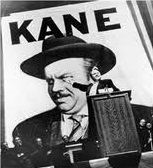
After watching Citizen Kane 3 times trying to understand why it is considered by many the greatest movie ever made, I can at least say that I think it is better than How Green Was My Valley.  Not that How Green was bad, because it wasn't, but Citizen Kane was more innovative and unique.

I still can't really see why Citizen Kane is thought to be the greatest film of all time, but I would like to hear the arguments for it.  The acting is definitely first rate, especially Orson Welles himself.  I also understand that the flashback style of film-making was quite new for the time, and that certain camera shots were very unique, though most of this is lost on me, not being an expert on filming techniques in the 1940s.

Orson Welles gave a powerful performance as Charles Foster Kane, an amalgamation of newspaper tycoon William Randolph Hearst and other powerful figures of the time.  We see the life of Kane through the memories of those that knew him, as a reporter does research trying to discover the meaning behind his last word.

William Randolph Hearst and Marion Davies.

If Kane really was supposed to be Hearst, and at least Hearst thought he was (he fought the film tooth and nail), I don't love the idea of creating a negative biopic about someone still living.  I think it's presumptuous to try to get inside someone's head and assume they are basically heartless.  I watched RKO 281, a movie about the making of Citizen Kane.  In that depiction, Welles is definitely guilty of taking for granted that he knows Hearst inside and out, without really knowing him, and he hurts both Hearst and Marion Davies (Hearst's longtime mistress) in the process.  Of course, RKO 281 is doing the same thing, trying to imagine what Welles was thinking, and we can't really know how much Welles actually intended Kane to be Hearst.  He certainly seemed to downplay his influence later, and especially denied that Susan Alexander was based on Davies.  He is quoted by Wikipedia as saying:

"That Susan was Kane's wife and Marion was Hearst's mistress is a difference more important than might be guessed in today's changed climate of opinion. The wife was a puppet and a prisoner; the mistress was never less than a princess. Hearst built more than one castle, and Marion was the hostess in all of them: they were pleasure domes indeed, and the Beautiful People of the day fought for invitations. Xanadu was a lonely fortress, and Susan was quite right to escape from it. The mistress was never one of Hearst's possessions: he was always her suitor, and she was the precious treasure of his heart for more than 30 years, until his last breath of life. Theirs is truly a love story. Love is not the subject of Citizen Kane."

It is my opinion that Citizen Kane should have won the Oscar, and Orson Welles should have won best actor for sure.

As a side note, my favorite movie of 1941 was That Hamilton Woman (Laurence Olivier and Vivien Leigh starred as Lord Horatio Nelson and Lady Emma Hamilton).  It was Winston Churchill's favorite movie, and how can you go wrong siding with Winston? 
Monday, October 1, 2012

1940 Rebecca

1940 Rebecca

"Last night I dreamt I went to Manderley again."

I have always loved this movie, in spite of the rather melancholy ending.  The book is terrific, and this is a great adaptation.

Laurence Olivier and Joan Fontaine (Vivien Leigh's husband and Olivia de Havilland's sister respectively, taking their turns in the spotlight after Gone With the Wind's success the year before), as Maxim de Winter and his wife (her name is never known).  They portray lovers haunted by the memory of Maxim's late wife, Rebecca.  Though deceased before the start of the movie, she is an ever present figure in the story -a figurative ghost taking center stage.

The story is full of romance and intrigue...Hitchcock is always great with mystery.  He supposedly kept Joan Fontaine looking like a deer in headlights by bullying her throughout filming.

The story revolves around the mystery behind the famous and beautiful Rebecca, beloved by all, as the new Mrs. de Winter tries to settle into her role as mistress of Maxim's great estate, Manderley.  The main character is wooed (if you can call it that -he treats her like a child and calls her a "little fool" in his proposal) from her position as a timid and poor "companion" to the humorously pretentious Mrs. Van Hopper by the rich widower, Maxim.  She is plagued by Rebecca's powerful and lingering presence in the minds of all those around her -especially the creepy housekeeper, Mrs. Danvers:

Mrs. Danvers: You wouldn't think she'd been gone so long, would you?  Sometimes, when I walk along the corridor, I fancy I hear her just behind me.  That quick light step, I couldn't mistake it anywhere.  It's not only in this room, it's in all the rooms in the house.  I can almost hear it now.  Do you think the dead come back and watch the living?
The Second Mrs. de Winter: N-no, I don't believe it.
Mrs. Danvers: Sometimes, I wonder if she doesn't come back here to Manderley, to watch you and Mr. de Winter together.

Our heroine is tormented by Rebecca's memory at every turn:

The Second Mrs. de Winter: How could we be close when I knew you were always thinking of Rebecca?  How could I even ask you to love me when I knew you loved Rebecca still?
Maxim de Winter: What are you talking about?  What do you mean?
The Second Mrs. de Winter: Whenever you touched me, I knew you were comparing me with Rebecca.  Whenever you looked at me or spoke to me, or walked with me in the garden, I knew you were thinking, "This I did with Rebecca, and this, and this."  It's true, isn't it?


The real romance of the story, in my mind, comes when Maxim finally tells his wife the truth of Rebecca, and she stands by him with fierce loyalty, loving him more than ever.

Maxim drove me a little nuts, particularly the lack of support he gives her when she moves to Manderley.  He also infantilizes her a bit, wanting her to always be a young, naive girl and never a woman, which is weird (ex. "It's gone forever, that funny young, lost look I loved won't ever come back." and "Please promise me never to wear black satin or pearls... or to be 36 years old.").  And come on, Mrs. Danvers should have been fired.  It was so clear she was unhinged that he really only has himself to blame for the events that follow -big surprise that the scary woman with one screw loose and an axe to grind causes destruction...come on, Maxim!